
Why Growing Ecommerce Stores Eventually Need osCommerce 4
Launching an ecommerce store has never been easier. Modern platforms promise quick setup, minimal technical effort, and instant results – and for many businesses, that works perfectly in the early stages.
But growth changes everything.
As traffic increases, catalogs expand, and business logic becomes more complex, many store owners begin to feel friction. Performance becomes harder to maintain, customization feels constrained, and each new requirement introduces additional complexity.
This is often the moment when ecommerce businesses start looking beyond “easy” platforms – and rediscover osCommerce, specifically its modern osCommerce 4 version, and why it still matters in modern ecommerce.
osCommerce is an open-source ecommerce platform that has evolved significantly in recent years. Its latest generation, osCommerce 4, is a modern, actively developed platform designed for performance, flexibility, and long-term scalability. Unlike plugin-driven systems or closed SaaS solutions, osCommerce 4 focuses on clean architecture and full control – making it particularly relevant for growing ecommerce businesses that have outgrown simpler platforms.
Contents
Ecommerce Growth Changes the Nature of the Platform
In the beginning, convenience is the priority. Speed to market matters more than architecture. Platforms like WooCommerce, OpenCart, PrestaShop, or SaaS solutions help stores validate ideas quickly.
However, as a store matures, priorities shift:
- Performance becomes critical, not optional
- Custom business logic replaces standard workflows
- Integrations with ERP, CRM, and third-party systems become essential
- Stability and predictability matter more than rapid feature additions
At this stage, the ecommerce platform is no longer just a tool – it becomes part of the business infrastructure.
This is where architectural decisions start to matter.
The Hidden Limits of Popular Ecommerce Platforms
Many popular ecommerce platforms are built around extensibility through plugins, modules, or apps. While this approach offers flexibility at first, it often introduces long-term challenges as stores grow.
When Plugins Become Technical Debt
As functionality increases, so does dependency:
- Multiple plugins performing overlapping tasks
- Performance overhead introduced with each extension
- Update conflicts and compatibility risks
- Difficulty tracing performance issues to a single source
Over time, the platform becomes harder to reason about, optimize, and scale. This is a key reason why many merchants look beyond popular platforms and evaluate alternatives that avoid these limitations. For a detailed comparison of these challenges, see our article “Why osCommerce Is the Smart Choice Over Shopify” which dives deeper into the limitations of popular SaaS ecommerce platforms.
Performance Stops Being Predictable
For growing stores, performance issues rarely appear all at once. They surface gradually – slower category pages, heavier database queries, longer checkout times – especially under peak traffic.
At this point, simply upgrading hosting resources no longer delivers proportional improvements. The limitation is not just infrastructure; it is how the platform itself operates.
osCommerce 4 – An Engineering-First Ecommerce Platform
osCommerce 4 approaches ecommerce from a fundamentally different direction.
Instead of hiding complexity behind layers of abstraction, it provides a clean, structured foundation that allows businesses and developers to build intentionally.
osCommerce 4 is not designed to be everything out of the box. It is designed to be shaped.
This makes it particularly well-suited for stores that require:
- Custom pricing or catalog logic
- Non-standard checkout flows
- Deep integrations with internal systems
- Long-term performance and maintainability
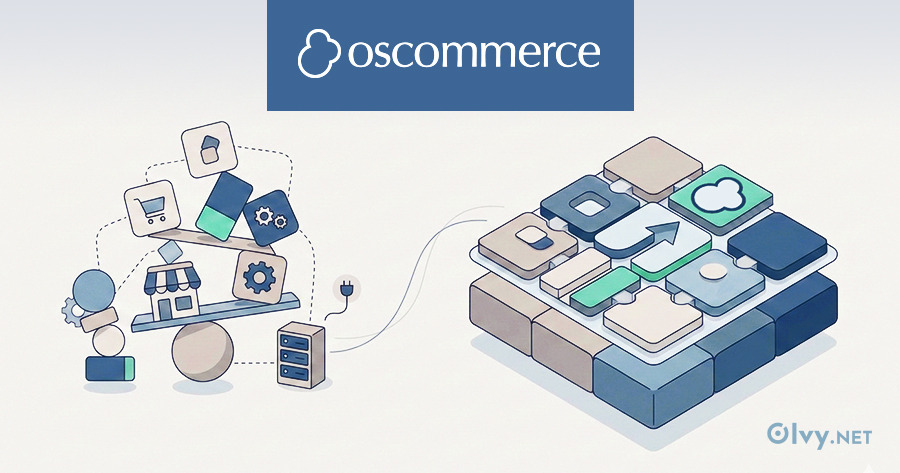
A useful comparison is a construction kit: osCommerce 4 provides strong, well-defined components that can be assembled precisely to match business needs – without unnecessary weight.
Flexibility Without Platform Lock-In
One of the defining advantages of osCommerce 4 is control.
Because it is fully open source and not driven by proprietary ecosystems, businesses retain ownership over:
- Codebase and data
- Hosting and infrastructure decisions
- Performance optimization strategies
- Long-term roadmap
For growing ecommerce businesses, this level of control often becomes a strategic requirement rather than a preference.
Performance Is a Platform and Hosting Decision
A common misconception in ecommerce is that performance problems can always be solved by “better servers.” In practice, performance is the result of how the platform and hosting environment work together.
osCommerce 4 is inherently performance-oriented, but it expects an environment that understands its execution model.
Why Bigger Servers Don’t Fix Everything
When hosted on generic environments, even well-architected platforms can underperform due to:
- PHP configurations not tuned for transactional workloads
- Databases not optimized for complex catalog queries
- Web server rules that don’t reflect real traffic patterns
- Caching layers that operate independently of application logic
This is why osCommerce 4 delivers its best results when paired with infrastructure designed specifically for it.
Why Generic Hosting Rarely Unlocks osCommerce’s Potential
Most hosting providers aim for maximum compatibility. One setup is expected to serve WordPress blogs, CMS sites, ecommerce platforms, and custom applications equally.
For osCommerce 4, this approach leaves performance on the table. Generic hosting environments typically lack:
- osCommerce-aware Nginx configurations
- PHP tuning based on real osCommerce workloads
- MariaDB optimization for large, dynamic catalogs
- Application-level performance monitoring
The result is a store that works – but does not scale efficiently.
Managed osCommerce Hosting as a Long-Term Strategy
Managed osCommerce hosting should not be viewed as a convenience. For growing ecommerce businesses, it is a strategic investment.
A purpose-built managed environment focuses on how osCommerce behaves in production – during traffic spikes, seasonal campaigns, and long-term data growth.
At Olvy, managed osCommerce hosting is designed around these realities, emphasizing:
- Stable performance under load
- Predictable scalability as traffic grows
- Infrastructure aligned with osCommerce internals
- Reduced operational complexity for store owners
osCommerce 4 vs Plugin-Driven Growth
As ecommerce projects mature, differences between platforms become more pronounced.
Plugin-driven platforms tend to grow horizontally – by adding more components, dependencies, and integration points.
osCommerce 4 grows vertically – by extending core logic in a controlled and intentional way.
This distinction becomes critical for stores that need:
- Custom business rules
- Precise performance tuning
- Predictable upgrades
- Long-term maintainability
osCommerce 4 vs Plugin-Driven Platforms
| Area | Plugin-Driven Platforms | osCommerce 4 |
|---|---|---|
| Performance | Degrades with plugins | Engineered at core |
| Custom Logic | Plugin-dependent | Native, code-level |
| Scaling | Often reactive | Predictable |
| Control | Platform-limited | Full ownership |
| Hosting Needs | Generic | Specialized |
For stores with serious technical and business requirements, osCommerce 4 is not a step backward – it is a step toward control and longevity.
Who Should Choose osCommerce 4 Today?
osCommerce 4 is not designed for every store, and that is its strength.
It is best suited for ecommerce businesses that:
- Have outgrown entry-level platforms
- Require custom functionality without workarounds
- Care deeply about performance and SEO
- Prefer open-source control over SaaS limitations
- Are building for long-term growth, not short-term convenience
For these stores, osCommerce 4 offers clarity instead of constraints.
Choosing the Right Hosting Partner Matters
Choosing osCommerce 4 without the right hosting partner is an incomplete decision.
A true managed osCommerce hosting provider should understand not just servers, but how ecommerce behaves in production – during traffic spikes, promotions, and business growth phases.
This is where Olvy positions itself not as a generic hosting provider, but as a long-term infrastructure partner for osCommerce-based businesses.
Final Thoughts: Building for the Next Stage of Growth
osCommerce 4 is not a platform of the past. It is a platform for ecommerce businesses that have reached a stage where control, performance, and flexibility matter more than simplicity.
When paired with managed hosting designed specifically for osCommerce, it becomes a powerful foundation for modern, scalable ecommerce.
For growing stores planning their next phase, osCommerce 4 – hosted the right way – deserves serious attention.
About Olvy ( www.olvy.net ) :
Olvy is a private and independent Limited Liability Company based in Bratislava, Slovakia, in the heart of Europe. We combined our invaluable 20+ years experience to develop innovative and reliable, lightning-fast and affordable Managed Cloud Hosting services for Everyone. From a small blog to a growing eCommerce – Olvy takes care of your website 24/7.
