
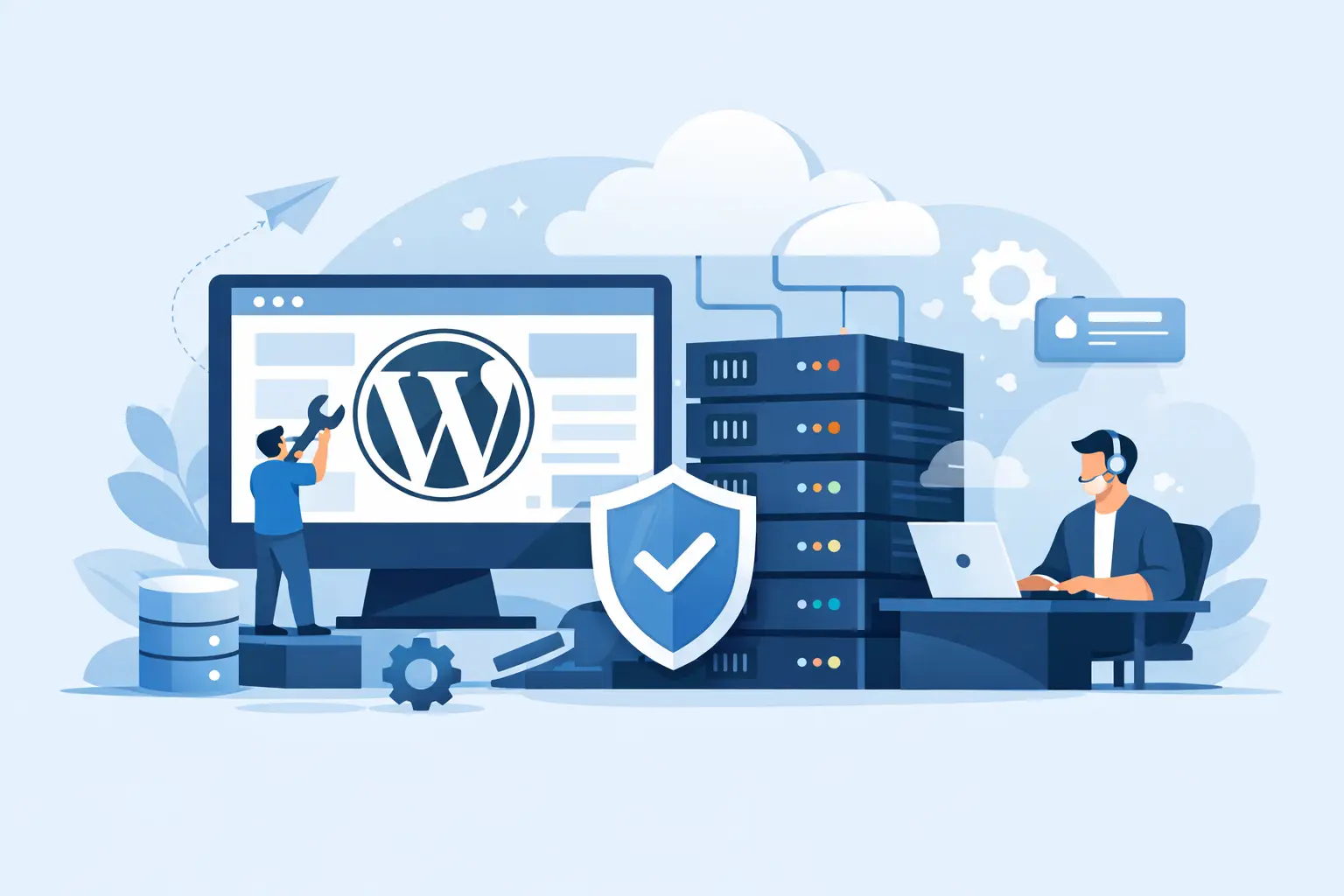
What Is Managed WordPress Hosting?
If your WordPress site is tied to leads, revenue, bookings, or customer trust, hosting stops being a background decision very quickly. That is why so many site owners ask, what is managed WordPress hosting, and is it actually different from the low-cost plans that all seem to promise the same thing.
The short answer is yes. Managed WordPress hosting is a hosting service built specifically for WordPress, where the provider takes operational responsibility for the environment that runs your site. That usually includes server setup, WordPress-specific performance tuning, security hardening, backups, monitoring, updates at the infrastructure level, and technical support from people who understand the stack.
That sounds simple enough, but the real difference is not a checklist of features. It is ownership. On generic hosting, you rent space. On managed WordPress hosting, you are paying for engineering, maintenance, and accountability around a WordPress workload.
Contents
What is managed WordPress hosting in practice?
In practice, managed WordPress hosting means the platform is configured for WordPress from the start, and the provider actively maintains it instead of leaving most of the heavy lifting to you.
With managed WordPress hosting, your provider handles updates, security, and performance optimization – similar to what we explain in our guide to fully managed hosting environments.
A standard shared hosting plan usually gives you a control panel, some basic resources, and a WordPress installer. From there, much of the responsibility becomes yours. If the site slows down under traffic, if the server needs tuning, if malware gets in, or if backups fail when you need them, you may be the one sorting it out.
Managed WordPress hosting changes that model. The hosting company is expected to manage the environment so WordPress runs faster, stays more secure, and creates less operational work for your team. That often includes caching configuration, database optimization, server-level security rules, uptime monitoring, backup systems, PHP management, SSL handling, and support that goes beyond reading from a script.
For business sites, that difference matters because WordPress performance is not just about code. It is affected by server resources, stack configuration, traffic isolation, background processes, image handling, bot traffic, and how well the hosting environment has been tuned for the application.
What you are actually paying for
The term “managed” gets used loosely in hosting, so it helps to be precise. You are not only paying for server space. You are paying for a provider to take responsibility for the health of the platform.
That usually covers infrastructure provisioning, operating system maintenance, patching, backup orchestration, malware prevention measures, monitoring, and support when something breaks. On stronger platforms, it also means WordPress-aware optimization instead of one-size-fits-all cloud instances.
For an agency, this can mean fewer support tickets from clients about slowness or downtime. For an online store, it can mean faster product pages, more stable checkout performance, and less risk during peak traffic. For an internal team, it can mean less time spent acting like accidental system administrators.
The best managed hosting providers are not just reselling commodity resources with a nicer label. They build and maintain environments around the needs of the CMS and the business running on it.
How managed WordPress hosting differs from shared, VPS, and cloud hosting
This is where a lot of confusion starts. Managed WordPress hosting is not the same thing as shared hosting, unmanaged VPS hosting, or raw cloud infrastructure.
Shared hosting is the cheapest option and usually the most crowded. Your site shares a server with many others, performance is inconsistent, and support is often broad rather than specialized. It can work for small brochure sites, but it is rarely the best fit for sites where speed and uptime affect business outcomes.
An unmanaged VPS gives you dedicated resources and more control, but it also gives you more responsibility. You may need to handle server hardening, package updates, web server tuning, backups, monitoring, and troubleshooting yourself. That is fine if you have Linux and DevOps expertise in-house. It is a poor bargain if you do not.
Cloud hosting refers to the infrastructure model, not the service level. A WordPress site can run on cloud infrastructure and still be poorly managed. What matters is who is operating the stack, how it is tuned, and whether someone is accountable when performance drops or incidents happen.
Managed WordPress hosting sits on top of infrastructure and adds service, specialization, and operational ownership. That is the piece many businesses actually need.
The real benefits of managed WordPress hosting
The first benefit is performance. WordPress can be fast, but only when the environment is configured correctly. That includes PHP workers, database behavior, page caching, object caching where appropriate, web server rules, and enough resources to handle traffic spikes without collapsing response times.
This is especially important because hosting speed directly impacts SEO rankings and conversions, as we explain in our article on why fast hosting matters for WordPress and WooCommerce.
The second benefit is security. WordPress itself is not inherently unsafe, but it is a common target because of its popularity. Most compromises happen through weak plugins, outdated components, poor access controls, or neglected servers. Managed hosting reduces that exposure by keeping the underlying system hardened and monitored.
The third benefit is reliability. A site that times out during a product launch or goes down after a plugin conflict is not just a technical problem. It is a business problem. Managed environments are built to reduce preventable failures and to respond faster when problems do occur.
The fourth benefit is support quality. Good managed WordPress hosting gives you access to people who understand WordPress behavior at the server level. That matters when the issue is not simply “is the server on,” but “why are admin-ajax calls spiking CPU and slowing checkout?”
Behind the scenes, this is handled by experienced engineers who continuously monitor and optimize the infrastructure – something we describe in more detail in how Olvy team keeps hosting fast and secure.
Where managed WordPress hosting makes the most sense
Not every WordPress site needs a fully managed environment. If you run a low-traffic personal blog, enjoy handling technical tasks yourself, and can tolerate occasional issues, lower-cost hosting may be enough.
Managed WordPress hosting makes more sense when the site has business weight behind it. That includes WooCommerce stores, lead generation sites, membership platforms, publisher sites with traffic spikes, multisite environments, and agency-managed client portfolios, where WooCommerce hosting requirements can be more demanding.
It is especially useful when downtime has a clear cost. If a slow site hurts conversion rate, if an outage interrupts orders, or if your team is spending too many hours maintaining servers instead of growing the business, managed hosting usually pays for itself in reduced risk and recovered time.
What managed WordPress hosting does not solve
A good provider can do a lot, but it cannot fix every issue inside the application.
If your site is overloaded with poor-quality plugins, badly written custom code, oversized media, or a bloated theme, hosting alone will not turn it into a high-performance system. It can give that site a stronger foundation and remove infrastructure bottlenecks, but application problems still need application-level work.
This is why serious providers look at the full picture. Sometimes the answer is more server resources. Sometimes it is plugin cleanup, database tuning, cron optimization, or changing how WooCommerce search and cart fragments are handled.
That nuance matters. If a hosting company claims it can solve every speed problem automatically, be skeptical.
How to evaluate a managed WordPress host
Look past marketing phrases and ask operational questions. Who manages the server stack? What exactly is included in backups, monitoring, and security hardening? Is support handled by real engineers or by frontline agents escalating basic tickets? How is the platform tuned for WordPress traffic and plugin behavior?
You should also ask how migrations are handled, what happens during incidents, how isolated accounts are, and whether the platform is suitable for WooCommerce if you sell online. eCommerce has different demands than a standard content site. Checkout flows, logged-in users, dynamic carts, and order processing create heavier and less cache-friendly workloads.
If the answers are vague, the service may be little more than repackaged hosting. Strong managed providers are usually very clear about what they own and how they operate.
For businesses that need more than generic hosting, this engineered approach is the real value. Providers such as Olvy position managed hosting around hands-on cloud engineering, not just a dashboard and a support queue, and that distinction matters when the site is central to revenue.
Is managed WordPress hosting worth it?
If your WordPress site is mission-critical, usually yes.
It is worth it when you need speed that holds up under real traffic, security practices that go beyond plugin alerts, and support from people who can work the problem at the server level. It is also worth it when your team should be focused on marketing, content, sales, or product operations instead of maintaining infrastructure.
If your site is small, static, and nonessential, the extra cost may not make sense. That is the trade-off. Managed hosting is not the cheapest option, but it is rarely purchased for the sake of being cheap. It is purchased to reduce operational risk and improve outcomes that have a dollar value attached.
The better question is not whether managed WordPress hosting costs more. It is whether unmanaged complexity, weak performance, and preventable downtime are already costing you more than you think.
A good hosting partner should make WordPress feel less fragile, less time-consuming, and far more dependable. When that happens, hosting stops being a recurring headache and starts acting like part of your operating foundation.
About Olvy ( www.olvy.net ) :
Olvy is a private and independent Limited Liability Company based in Bratislava, Slovakia, in the heart of Europe. We combined our invaluable 20+ years experience to develop innovative and reliable, lightning-fast and affordable Managed Cloud Hosting services for Everyone. From a small blog to a growing eCommerce – Olvy takes care of your website 24/7.
