
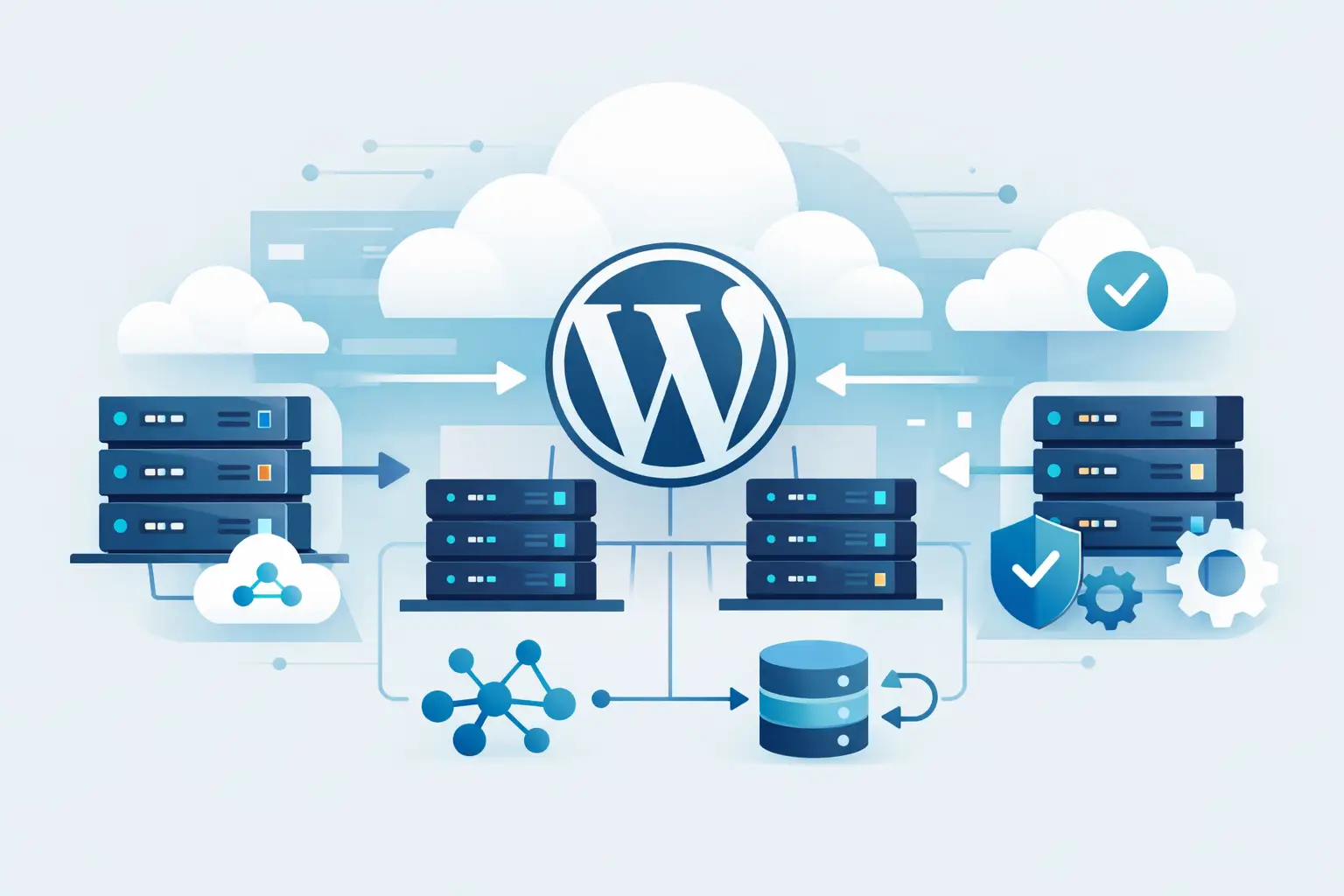
High Availability WordPress Hosting Explained
A five-minute outage during a sales campaign is not a hosting annoyance. It is lost revenue, failed checkouts, broken ad spend, and a support queue that starts filling up before your team knows what happened. For ecommerce businesses, infrastructure instability often appears first through slower transactional pages and degraded checkout responsiveness. That is why high availability WordPress hosting matters for any business that depends on WordPress to generate leads, publish content, or process orders.
For many site owners, hosting decisions start with speed and price. Those matter, but availability is what keeps the business operating when traffic spikes, hardware fails, updates misbehave, or an upstream service has a bad day. If your website is a business system, availability is not an upgrade. It is part of the foundation.
Contents
What high availability WordPress hosting actually means
High availability WordPress hosting is designed to reduce single points of failure. Instead of relying on one server, one disk, one database instance, or one manual recovery path, it uses redundant infrastructure and operational controls so the site stays online even when a component fails.
That sounds straightforward, but in practice it is not just about adding more servers. A poorly designed cluster can still fail if the database is isolated on a single node, if storage becomes a bottleneck, or if failover exists only on paper. Real high availability is an engineering discipline. Reliable uptime depends not only on redundant infrastructure, but also on how the environment is engineered, monitored, and maintained over time. It combines architecture, monitoring, automation, backups, security hardening, and people who know how to operate the stack under pressure.
For WordPress, that matters even more because the platform is dynamic. Logins, admin activity, checkout sessions, plugin behavior, scheduled tasks, search indexing, and cache invalidation all create moving parts. A brochure site and a busy WooCommerce store may both run on WordPress, but their availability requirements are very different.
Why standard hosting often falls short
A lot of hosting marketed as reliable is really just conventional hosting with decent uptime history. That is not the same as high availability. A single VPS with backups can be perfectly adequate for some websites, but it is still one machine. If the node has a hardware issue, if the filesystem corrupts, or if a bad update brings down services, the site is offline until recovery is complete. Consistent maintenance and update management are often what separate stable WordPress environments from recurring outage cycles.
Backups are essential, but backups are not availability. They help you restore after failure. High availability is about continuing to serve traffic during failure, or recovering so quickly that disruption is minimal.
This is where many businesses get caught between assumptions and reality. They assume cloud means automatic resilience. It does not. You can run WordPress in the cloud and still build a fragile environment. Cloud infrastructure gives you options. Engineering is what turns those options into dependable uptime.
The core components behind high availability
At the application layer, WordPress typically needs multiple web nodes behind a load balancer. That spreads traffic and allows one node to fail or be removed for maintenance without taking the entire site down. For stateless traffic, this is relatively clean. The complexity appears when sessions, media, cron jobs, and plugin-specific behavior enter the picture.
The database layer is even more critical. WordPress depends heavily on MySQL or MariaDB, and databases are often the hardest part to make highly available. Replication, failover strategy, consistency, and split-brain protection all have to be handled carefully. Fast failover sounds good until it introduces data corruption or stale reads. For stores, membership sites, and other transactional workloads, database design is where availability planning becomes serious.
Storage matters too. Shared media, uploads, and persistent files need a strategy that does not leave one web node out of sync with another. Some environments use network-attached storage. Others use object storage with application-level integration. There is no universal answer. The right choice depends on traffic patterns, plugin behavior, and performance requirements.
Then there is DNS, SSL management, monitoring, firewalling, and backup orchestration. If these are manual or loosely maintained, recovery slows down exactly when speed matters most. High availability is not one feature. It is the result of many systems working correctly together.
High availability WordPress hosting for WooCommerce and revenue sites
If you run WooCommerce, the case for high availability gets stronger. Shopping carts, payment callbacks, inventory changes, customer accounts, and order processing create a workload that is less forgiving than a standard content site. You are not just protecting page views. You are protecting transactions.
This changes the hosting conversation. Aggressive full-page caching can improve performance, but parts of the store must stay dynamic. Session handling becomes more important. Database write load increases. Background jobs need to complete reliably. During promotions or seasonal demand, a traffic spike can become a database bottleneck long before CPU looks stressed. Many WordPress performance problems only become visible once real traffic and dynamic ecommerce workloads hit the infrastructure.
That is why performance and availability should be planned together. A fast environment that collapses under load is not reliable. An overly redundant environment that introduces latency and complexity is not well engineered either. The goal is a balanced stack that stays responsive while tolerating failure.
Not every website needs the same level of redundancy
This is where the trade-offs matter. Some businesses genuinely need multi-node application tiers, database replication, and aggressive monitoring with engineer-led response. Others may be better served by a hardened single-server architecture with excellent backups, patching discipline, and rapid recovery procedures.
The deciding factors are usually business-driven, not purely technical. Ask what one hour of downtime costs. Consider campaign timing, SEO impact, customer trust, support load, and whether transactions are interrupted. A local service business with moderate traffic may not need the same architecture as a national online store processing orders around the clock.
High availability also costs more. There are more moving parts, more infrastructure, and more operational complexity to manage. That cost is justified when downtime is expensive. It is less justified when the business can tolerate a short outage and prioritize simplicity instead.
What to look for in a managed hosting provider
If you are evaluating managed hosting, the right question is not simply whether the provider offers high availability WordPress hosting. Ask how it is engineered, operated, and supported.
You want clarity on architecture. Are there multiple application nodes? How is database failover handled? What happens if a node fails at 2:00 a.m.? How are backups stored and tested? Is monitoring proactive or just alert forwarding? Who applies security patches, reviews performance bottlenecks, and validates that the stack is behaving correctly after changes? High availability environments also depend on disciplined security operations and proactive infrastructure hardening.
Support quality matters as much as infrastructure design. During an incident, scripted first-line replies are not enough. You need real engineers who can read logs, isolate failures, assess whether the issue is application-level or system-level, and act without escalating through several layers of support.
That is also why engineered managed hosting stands apart from commodity plans. The value is not just server space. It is operational ownership. Providers like Olvy build around this principle, combining managed cloud infrastructure with system-level engineering, hardening, monitoring, and performance tuning for businesses that cannot afford generic hosting behavior.
Common misconceptions that lead to downtime
One of the most common mistakes is assuming a CDN alone creates high availability. A CDN helps with distribution and can absorb some traffic pressure, but it does not fix an unhealthy origin, database issues, or application failures.
Another is treating plugin quantity as the main risk factor while ignoring infrastructure quality. Bad plugins can absolutely cause trouble, but even well-built sites become unstable on weak hosting architecture. The reverse is also true. Excellent infrastructure cannot fully compensate for poorly maintained code. Availability depends on both layers.
There is also a tendency to over-focus on uptime percentages without asking how they are achieved. A provider can advertise strong uptime while excluding maintenance windows, measuring only network reachability, or leaving recovery details vague. What matters is not marketing language. It is whether the site remains usable when parts of the system fail.
The business case is stronger than the technical case
Executives and site owners do not need to love infrastructure diagrams to make a smart decision here. The business case is simple. Better availability protects revenue, preserves trust, stabilizes marketing performance, and reduces the operational drag that comes from recurring incidents.
It also gives teams room to move faster. Updates, traffic events, and growth are easier to manage when the environment has resilience built in. Developers work with more confidence. Marketing teams stop worrying that every promotion might break the site. Operations teams spend less time reacting and more time improving.
For WordPress, that shift matters. The platform can scale well, but only when the hosting architecture respects how WordPress actually behaves under real business load.
If your website has become critical infrastructure for your company, treat it that way. High availability is not about adding complexity for its own sake. It is about building a hosting foundation that keeps the business online when conditions are less than ideal.
About Olvy ( www.olvy.net ) :
Olvy is a private and independent Limited Liability Company based in Bratislava, Slovakia, in the heart of Europe. We combined our invaluable 20+ years experience to develop innovative and reliable, lightning-fast and affordable Managed Cloud Hosting services for Everyone. From a small blog to a growing eCommerce – Olvy takes care of your website 24/7.
