
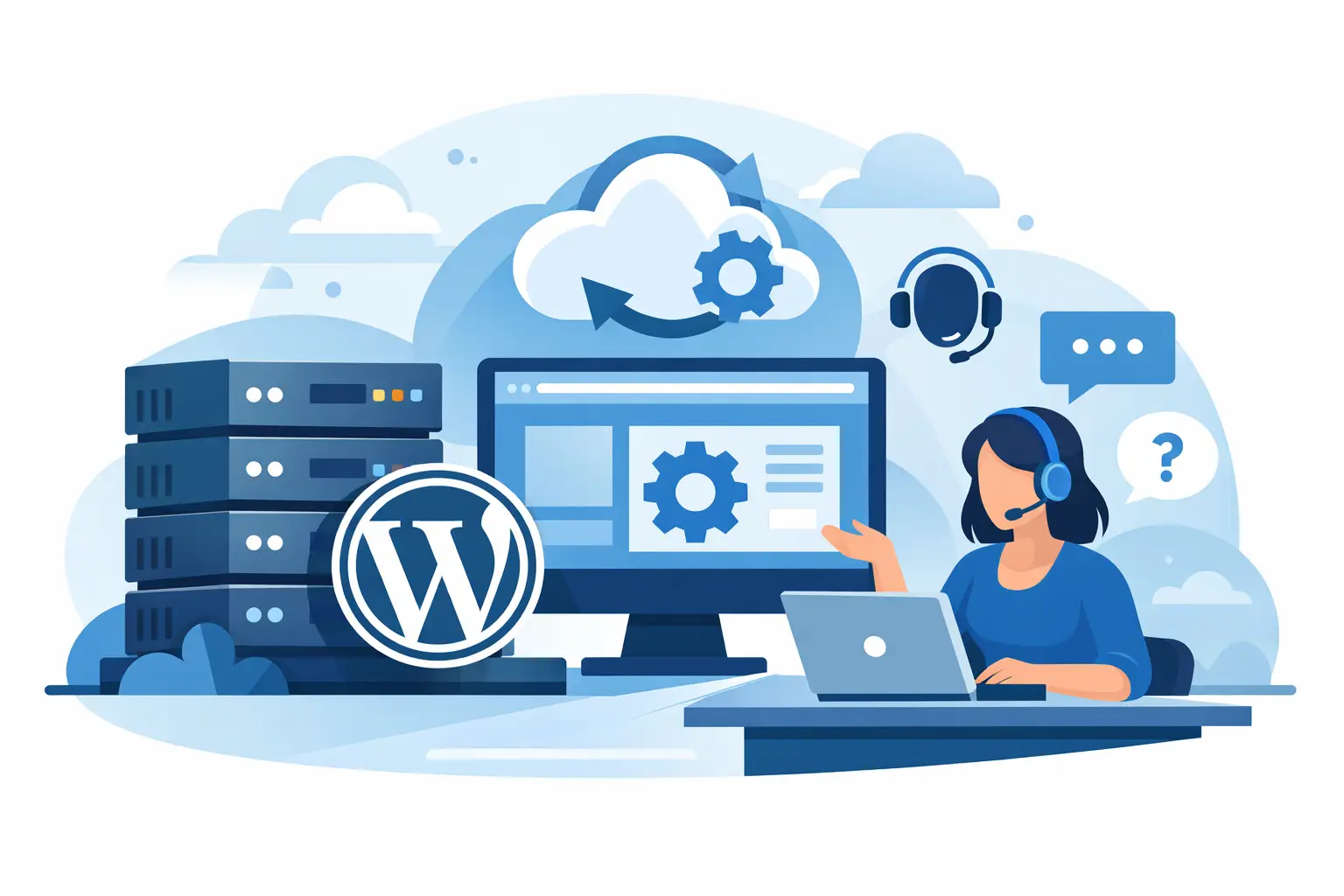
WordPress Hosting With 24/7 Support
A WordPress site rarely fails at a convenient time. Checkout errors show up after business hours. Plugin conflicts hit right before a campaign. A traffic spike lands on a weekend. That is why wordpress hosting with 24 7 support matters most when your site is tied directly to leads, sales, and customer trust.
The problem is that not all support is really support. Many hosting providers advertise 24/7 availability, but what they actually offer is ticket triage, scripted responses, and slow escalation. If your site is performance-critical, that gap becomes expensive fast. The better question is not whether a host answers around the clock. It is whether qualified engineers can actually solve infrastructure and WordPress problems when they happen.
Contents
What wordpress hosting with 24 7 support should actually mean
For a business site, support should extend beyond password resets and billing questions. It should cover the stack your website depends on – web server, PHP, database performance, caching, backups, security controls, SSL, uptime monitoring, and the WordPress application itself.
This is where the difference between commodity hosting and engineered hosting becomes obvious. A generic provider may keep the server online and leave the rest to you. A managed provider with real engineering depth takes ownership of the environment, tunes it for WordPress, hardens it against common attack paths, and responds when something degrades. This is the difference between basic hosting and a fully managed environment. If you want a broader explanation, see what managed WordPress hosting is and why your website needs it.
If you run WooCommerce, the stakes are even higher. A slow cart, failed checkout session, or database bottleneck is not a technical annoyance. It is lost revenue. Support has to be able to diagnose query load, cache behavior, PHP worker limits, bot traffic, and plugin-level strain without treating every issue like a basic help desk ticket.
Why support quality affects speed, uptime, and revenue
Hosting is often evaluated on storage, bandwidth, and price. Those are easy numbers to compare, but they rarely tell you how the service performs under pressure. Support quality has a direct impact on business outcomes because incidents are rarely isolated to one layer.
A slow WordPress site can come from inefficient plugins, poor database indexing, exhausted server resources, uncached dynamic pages, or bad bot traffic. If support only sees the issue at the application level, the root cause can persist for days. If they only see infrastructure, they may miss the theme or plugin behavior that triggered it. Real 24/7 support means someone can follow the problem across the full stack. This is also why hosting performance and support quality are closely connected. We explore this further in why fast hosting matters for your WordPress and WooCommerce.
That matters for uptime too. Most outages are not dramatic full-server failures. More often, they are partial failures – intermittent database timeouts, failed cron jobs, misconfigured caching, SSL renewal issues, or resource spikes that affect only some users. These are harder to detect and harder to fix without experienced operators.
For online stores and lead generation websites, every extra minute of instability has a cost. Users leave. Ad spend gets wasted. Search performance can suffer over time. Internal teams get pulled into firefighting instead of growth work.
The difference between staffed support and engineer-led support
This distinction is where many buyers get burned. A host can promise 24/7 support and still provide very little technical ownership.
Staffed support usually means someone is available to reply at any hour. That sounds reassuring, but the response may be limited to acknowledgement, not resolution. You get a message saying the issue has been passed to another team. Hours later, the real investigation begins.
Engineer-led support is different. The person reviewing the incident understands Linux systems, web server behavior, PHP execution, database performance, and WordPress-specific hosting requirements. They can inspect logs, adjust services, isolate load patterns, identify security anomalies, and make corrective changes without unnecessary handoffs.
For serious websites, this is the model that reduces downtime and operational drag. It also changes the relationship. You are not renting server space and hoping for the best. You are working with a hosting partner that takes responsibility for the runtime environment.
What to look for in WordPress hosting with 24/7 support
Start with scope. Ask what support actually covers. If the answer stops at infrastructure availability, you are still carrying most of the risk. A stronger managed service should include server setup, hardening, updates, backups, monitoring, SSL handling, and ongoing performance oversight.
Next, ask who provides support. Are they frontline agents reading scripts, or are they Linux and cloud engineers with authority to troubleshoot the stack? That single detail often matters more than the headline plan features.
You should also look at how the hosting environment is built. WordPress performs best on stacks that are tuned intentionally, not deployed as one-size-fits-all templates. The right setup depends on your traffic pattern, plugin mix, admin activity, and whether the site is content-heavy, membership-based, or transactional.
Security is another separating line. Basic hosting may offer malware scanning and leave it there. A stronger provider treats security as an operational discipline – hardened systems, controlled access, patch management, monitoring, backup integrity, and preventive maintenance.
Finally, pay attention to migration and onboarding. A provider that offers free migration and takes responsibility for moving the site cleanly is often signaling something important: they are willing to own the result, not just provision the account.
When cheap hosting becomes expensive
Budget hosting can be fine for low-traffic hobby sites. It is a poor fit for businesses that rely on WordPress for revenue or reputation. Shared resources, generic tuning, weak isolation, and thin support may keep monthly costs low, but they push hidden costs back onto your team. These limitations are typical of shared environments, where multiple sites compete for the same resources without guarantees of performance or stability. A clearer breakdown of these trade-offs is covered in managed WordPress hosting vs shared hosting.
Those costs show up as slower pages, plugin conflicts that linger unresolved, security cleanup after preventable compromises, and internal time spent managing issues that should never have reached the business. The sticker price looks attractive until a campaign underperforms because the site could not keep up.
This is why experienced site owners eventually stop buying hosting as a commodity. They start buying accountability. That includes predictable performance, stronger uptime, and support that can act decisively when something breaks.
Who benefits most from this kind of hosting
Not every site needs the same level of management. But if your WordPress installation supports eCommerce, lead generation, publishing at scale, or agency client workloads, 24/7 expert support stops being a nice feature and becomes part of your operating model.
Growing WooCommerce stores benefit because transaction paths are sensitive to load, plugin interactions, and cache rules. Agencies benefit because infrastructure incidents can affect multiple client relationships at once. Small businesses benefit because they often do not have in-house sysadmins and cannot afford prolonged downtime. Developers benefit because they can focus on product and code instead of server maintenance.
For these teams, the best hosting arrangement is one where infrastructure complexity is handled by specialists who understand both cloud systems and WordPress behavior.
A practical way to evaluate providers
Before choosing a host, test their operational maturity. Ask how they handle active incidents at 2 a.m. Ask whether they investigate performance issues that are not total outages. Ask what they proactively manage, what they monitor, and what they consider outside scope.
Then ask technical questions that expose depth. How do they approach caching for WooCommerce? How are backups verified? What hardening steps are standard? How do they monitor server health and application availability? A provider with real engineering behind the service will answer clearly and specifically.
This is also where a company like Olvy stands apart. The value is not just managed hosting on paper. It is engineered hosting backed by real people who can tune, secure, monitor, and maintain WordPress environments with the seriousness business sites require.
The real standard is confidence
The best wordpress hosting with 24 7 support gives you something more valuable than a support badge. It gives you confidence that when traffic rises, updates clash, or infrastructure behaves badly, someone qualified is already on it.
That confidence changes how you run your website. You can move faster, market harder, and scale with fewer operational compromises. And if your site is central to how your business earns trust or revenue, that is not a luxury. It is the baseline you should expect.
About Olvy ( www.olvy.net ) :
Olvy is a private and independent Limited Liability Company based in Bratislava, Slovakia, in the heart of Europe. We combined our invaluable 20+ years experience to develop innovative and reliable, lightning-fast and affordable Managed Cloud Hosting services for Everyone. From a small blog to a growing eCommerce – Olvy takes care of your website 24/7.
