
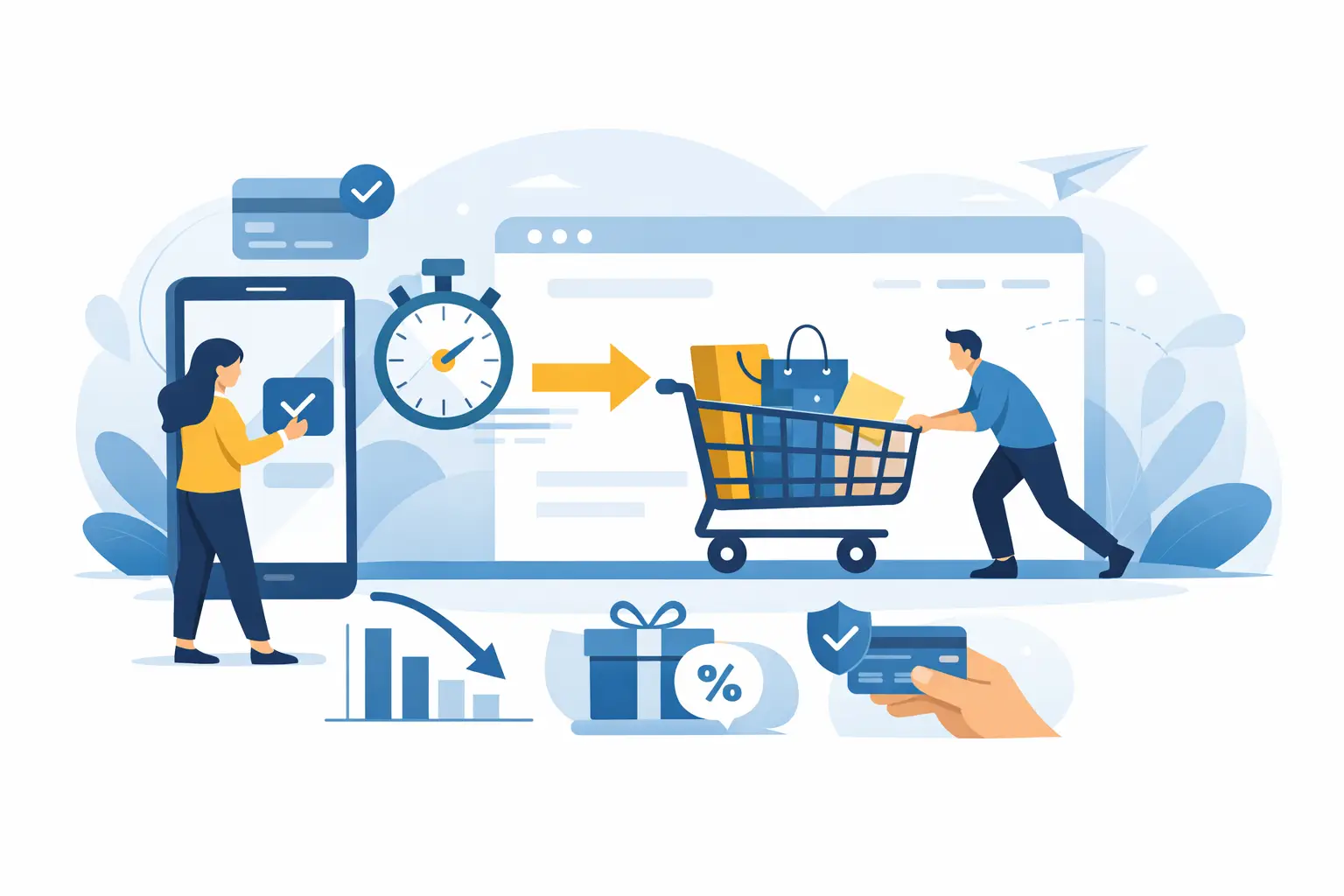
How to Reduce Cart Abandonment Fast
A shopper adds two products, reaches checkout, pauses at the shipping total, waits three extra seconds for the page to load, and disappears. That sequence happens thousands of times a day across eCommerce stores, which is why learning how to reduce cart abandonment is not a marketing nice-to-have. It is a revenue protection job.
Cart abandonment is rarely caused by one issue alone. More often, it is a chain of small failures: slow pages, unclear costs, unnecessary form fields, weak trust signals, awkward mobile behavior, or payment friction. If your store runs on WooCommerce, Magento, PrestaShop, OpenCart, osCommerce, or another CMS, the challenge gets even sharper because platform complexity can quietly affect the buying experience in ways many teams do not catch until conversion rates start slipping.
Contents
How to reduce cart abandonment starts with friction
Most abandoned carts are a response to friction, not lack of intent. The customer was interested enough to add a product. Something in the path to payment made finishing the purchase feel slower, riskier, or more expensive than expected.
That means the right question is not just, “Why are people leaving?” It is, “Where does the checkout ask for more effort than the purchase feels worth?” Sometimes the answer is obvious, like forced account creation. Sometimes it is operational, like a checkout page that slows down under traffic or a payment gateway that fails intermittently.
Teams often overinvest in top-of-funnel acquisition while underinvesting in the last two minutes of the session. That is backwards. Improvements at checkout usually have a more direct impact on revenue than another campaign pushing more people into a broken process.
Remove surprises before checkout
Unexpected costs are one of the most common reasons people abandon carts. Shipping fees, taxes, handling charges, and long delivery windows can all change the perceived value of the purchase at the worst possible moment.
The fix is not always “offer free shipping.” That depends on your margins. For some stores, free shipping thresholds work well. For others, clearer shipping estimates on product and cart pages are the smarter move. What matters is reducing the gap between what the customer expects and what they actually see at checkout.
The same goes for delivery timing. If an item ships in three weeks, say so early. If inventory is limited, be precise. Customers can tolerate constraints. They are less tolerant of ambiguity.
Speed matters more than many teams admit
A slow checkout feels unsafe. That is the commercial reality. When pages lag, totals spin, or payment steps hesitate, shoppers do not assume your infrastructure is busy. They assume something might go wrong with their order or card.
This is where conversion and infrastructure meet. If your eCommerce stack is underpowered, poorly tuned, or sharing resources in the wrong environment, the checkout experience starts absorbing the impact long before teams notice it. For stores reviewing the infrastructure side of conversion problems, choosing the right eCommerce hosting environment often becomes part of the solution. Database-heavy platforms such as WooCommerce and Magento are especially sensitive during cart and checkout activity because those pages generate dynamic requests that are harder to cache.
Improving load time on product pages is useful. Improving speed on cart, checkout, and payment callbacks is more valuable. That requires disciplined engineering: tuned PHP workers, optimized databases, proper object caching where appropriate, efficient theme and plugin choices, and hosting built for transaction-heavy traffic rather than brochure-style websites. As stores grow, many of the same performance patterns appear around worker limits, database pressure, and plugin overhead that show up in larger WooCommerce scaling challenges. For stores where every minute of downtime or latency affects sales, this is not background IT work. It is conversion infrastructure.
Make checkout shorter, but also smarter
A shorter checkout usually converts better, but only if it remains clear. Removing fields blindly can create downstream issues with fraud checks, fulfillment, or customer support. The goal is not minimalism for its own sake. The goal is justified effort.
Ask only for what you need to process and deliver the order. If a phone number is optional, treat it that way. If billing and shipping are often the same, let customers confirm with one click. If account creation helps retention, offer it after purchase or make guest checkout available alongside it.
Mobile deserves special attention here. A checkout form that feels acceptable on desktop can become irritating on a phone. Long dropdowns, poor keyboard behavior, tiny tap targets, and slow address validation can quietly kill conversions. Since a large share of eCommerce traffic now comes from mobile devices, every unnecessary interaction carries more cost.
Build trust at the point of decision
Trust signals work best when they reduce specific concerns. Generic badges scattered around the page do less than clear, relevant reassurance placed where hesitation actually occurs.
At checkout, customers want to know their payment is secure, returns are reasonable, delivery is predictable, and the business is legitimate. That can come through secure payment logos, concise return messaging, visible contact details, real company information, and a checkout design that feels consistent with the rest of the store. If users suddenly land on a clunky or off-brand payment page, confidence drops.
There is a trade-off here. Too many trust elements can create noise and visual clutter. Keep the reassurance focused and credible. A small amount of precise information usually outperforms a wall of badges.
Offer payment options that match buying behavior
You cannot reduce cart abandonment if customers reach the payment step and do not see a method they trust or prefer. Card support is table stakes. Depending on your audience, digital wallets, buy now pay later options, bank transfers, or region-specific payment methods may matter just as much.
This is one of those areas where “best practice” depends on who you sell to. A US-based consumer brand might benefit heavily from Apple Pay, Google Pay, PayPal, and installment options. A B2B store may need PO flows or invoicing. An international merchant may lose sales if local payment expectations are ignored.
Just as important, your payment integrations need to be reliable. Failed transactions, duplicate charges, and callback errors create immediate abandonment and long-term trust damage. If your checkout stack is prone to plugin conflicts or API instability, that is an engineering problem with direct commercial consequences.
Use recovery tactics, but do not rely on them
Abandoned cart emails and retargeting campaigns can recover some lost revenue, and they are worth running. But they should support your checkout strategy, not excuse a weak checkout.
If you do use recovery flows, timing matters. A reminder sent within a few hours often performs better than one sent days later. The message should be simple: remind the shopper what they left behind, reinforce confidence, and remove one source of hesitation such as delivery clarity or returns information. Discounting can help, but it should not be your first move. If customers learn that abandoning the cart triggers an offer, you may train the wrong behavior.
Measure the exact point of abandonment
If you want to know how to reduce cart abandonment in a meaningful way, stop looking only at the overall abandonment rate. That number is too broad to guide action.
You need to know where users drop: cart page, login step, shipping selection, payment entry, order review, or post-payment confirmation. You also need to segment by device, traffic source, geography, and returning versus new customers. A mobile-only drop at the payment stage points to a very different issue than a broad decline after shipping costs are shown.
Operational metrics matter too. Monitor checkout response times, server resource pressure, third-party script behavior, payment gateway errors, and failed background jobs. Revenue teams and engineering teams should be looking at the same journey from different angles. That is where the useful answers usually are.
Infrastructure is part of checkout optimization
Many articles on cart abandonment stay in the world of copy, coupons, and UX. Those things matter, but stores built on CMS-based commerce platforms also live or die by execution at the server and application level.
If traffic spikes cause slowdown, if plugin sprawl creates instability, if security issues undermine trust, or if backups and maintenance are reactive instead of controlled, the store will eventually leak revenue through abandonment. High-converting eCommerce operations do not treat hosting as a commodity. They increasingly treat infrastructure as part of the revenue system because operational work around performance, monitoring, maintenance, and stability directly affects the buying journey – especially when managed infrastructure takes ownership of those layers.
That is why businesses with serious revenue at stake often move toward engineered managed environments with proactive monitoring, hardening, performance tuning, and hands-on support from real engineers. The benefit is not technical elegance for its own sake. The benefit is a faster, more stable checkout when customers are closest to purchase.
The best path forward is usually not a dramatic redesign. It is disciplined improvement: make costs clearer, remove unnecessary steps, strengthen trust, support the right payment methods, and make sure your infrastructure can carry the load without hesitation. When checkout feels fast, predictable, and safe, more shoppers finish what they already intended to buy.
That is the practical side of conversion work – not chasing more carts, but losing fewer of the ones you already earned.
About Olvy ( www.olvy.net ) :
Olvy is a private and independent Limited Liability Company based in Bratislava, Slovakia, in the heart of Europe. We combined our invaluable 20+ years experience to develop innovative and reliable, lightning-fast and affordable Managed Cloud Hosting services for Everyone. From a small blog to a growing eCommerce – Olvy takes care of your website 24/7.
